
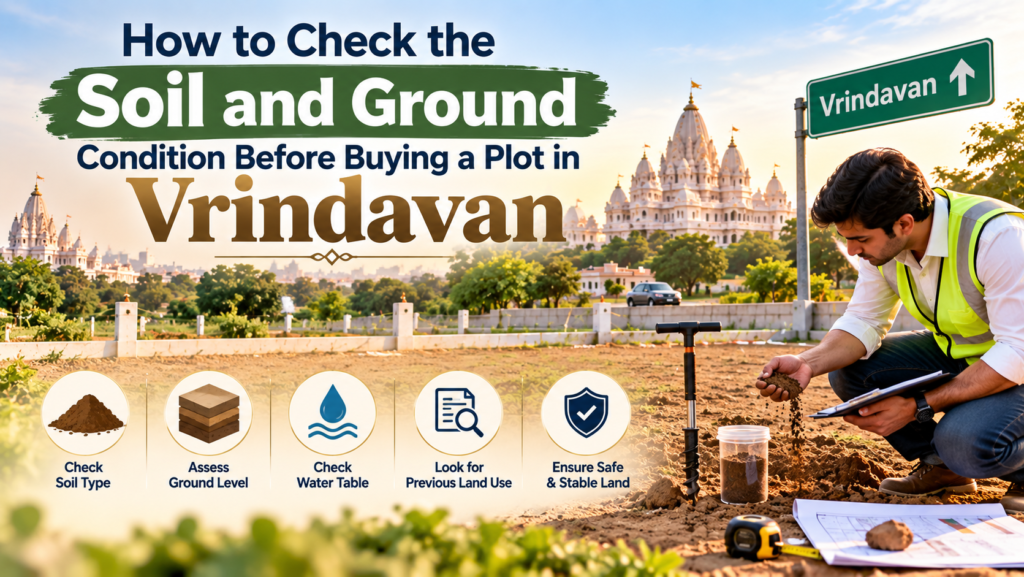
When buying a plot for future construction, buyers often focus on location, price, plot size and road access. However, the physical condition of the land is also an important factor to consider.
The ground condition can affect site preparation, drainage, foundation planning and construction requirements. If you are planning to buy a plot in Vrindavan, checking the site’s physical condition before purchase can help you understand the land more thoroughly.
This does not mean that buyers should try to determine soil suitability themselves. A qualified civil engineer or geotechnical professional can provide appropriate technical advice and testing where required.
1. Why Ground Condition Matters
The land beneath a future building needs to be assessed before construction planning.
Ground conditions can influence:
- Site preparation
- Foundation design
- Drainage planning
- Filling requirements
- Construction cost
- Water management
- Long-term building planning
The actual requirements depend on the specific site and proposed construction.
2. Look at the Existing Ground Level
During a site visit, observe whether the plot appears level with the surrounding road and properties.
Check for:
- Raised areas
- Low-lying sections
- Uneven ground
- Visible depressions
- Differences between the plot and road level
A significant difference in levels may require additional site preparation before construction.
3. Check for Signs of Waterlogging
Waterlogging can be an important site-condition concern.
Look for signs such as:
- Standing water
- Muddy areas
- Water marks
- Poor drainage around the plot
- Vegetation associated with consistently wet ground
- Damp surrounding areas
Also ask local residents or nearby property owners whether the area experiences water accumulation during heavy rainfall.
4. Observe the Surrounding Plots
The condition of neighboring properties can provide useful context.
During your visit, observe:
- Ground levels of nearby plots
- Existing boundary walls
- Nearby houses
- Drainage arrangements
- Road elevation
- Signs of settlement or water accumulation
However, neighboring conditions should only be treated as observations, not as a substitute for professional soil or site assessment.
5. Check Whether the Plot Has Been Filled
Some land parcels may have been raised using additional soil or other filling material.
Ask whether the plot has been:
- Filled
- Leveled
- Raised
- Excavated
- Previously used for another purpose
If significant filling has been carried out, ask for relevant details and consider professional assessment before planning construction.
6. Understand the Difference Between Soil Observation and Soil Testing
A visual inspection can identify obvious site conditions, but it cannot reliably determine all engineering properties of soil.
Soil testing can provide technical information relevant to construction, depending on the test and site.
A qualified professional may assess factors such as:
- Soil composition
- Bearing characteristics
- Moisture conditions
- Groundwater-related conditions
- Foundation-related requirements
The appropriate testing method depends on the proposed construction and site.
7. Consider the Future House You Plan to Build
The ground assessment should be considered alongside your intended construction.
A small residential structure and a larger multi-level building may have different engineering requirements.
Before finalizing the plot, think about:
- Proposed number of floors
- Approximate building size
- Parking
- Boundary wall
- Additional structures
- Future expansion
Share your intended construction plan with the relevant professional so the site can be assessed appropriately.
8. Check Drainage Around the Plot
Drainage is closely connected to ground conditions.
Check whether rainwater can move away from the plot effectively.
Look at:
- Nearby drains
- Road slope
- Plot elevation
- Neighboring ground levels
- Water outlet routes
- Areas where water tends to collect
Poor drainage can create practical problems even when the plot itself appears suitable.
9. Check the Road and Plot Level Together
Do not evaluate the plot level separately from the road.
Compare:
Road level → Plot entrance → Plot ground level → Surrounding properties
A significant difference between these levels may influence the way the site needs to be prepared.
Ask a professional to evaluate the appropriate finished ground level before construction if there are noticeable differences.
10. Look for Visible Cracks or Settlement Around the Site
Existing structures near the plot can sometimes provide clues about local ground conditions.
Observe nearby:
- Boundary walls
- Buildings
- Roads
- Pavements
Look for unusual settlement, major cracks or uneven surfaces.
These observations do not prove a soil problem, but they can be reasons to seek professional assessment before purchasing.
11. Ask About Previous Use of the Land
Knowing how the land was previously used can provide additional context.
Ask whether the site was previously:
- Agricultural land
- Vacant land
- A built-up property
- Used for storage
- Filled or excavated
- Used for another activity
Previous use does not automatically indicate a problem, but it can help professionals understand what additional checks may be appropriate.
12. Check for Nearby Water Sources
The presence of nearby water bodies, drains or low-lying areas can be relevant when evaluating site conditions.
Check the surroundings for:
- Drains
- Water channels
- Ponds
- Low-lying land
- Seasonal water accumulation areas
The purpose is not to assume that nearby water creates a problem, but to understand the site’s broader drainage and ground environment.
13. Ask About Seasonal Conditions
A plot can look different during different seasons.
If possible, ask local residents about the site during:
- Monsoon
- Winter
- Summer
Useful questions include:
- Does water collect here during heavy rain?
- Does the approach become difficult?
- Has the plot ever been raised?
- Are there drainage issues?
- Does the surrounding road flood or accumulate water?
Local observations can complement, but not replace, professional assessment.
14. Consider Site Preparation Costs
If the plot requires substantial preparation, the overall project budget may change.
Possible site-preparation work can include:
- Leveling
- Filling
- Compaction
- Drainage work
- Soil-related preparation
- Boundary preparation
Do not assume that every plot will require the same work. Get a professional estimate based on the actual site.
15. Do Not Judge Land Quality Only by Appearance
A plot that looks dry and level may still require technical evaluation before construction.
Similarly, visible soil differences do not automatically mean that a plot is unsuitable.
Factors such as foundation design and construction requirements should be determined by qualified professionals based on the site and proposed structure.
16. Check Construction Requirements Before Finalizing
If you have already decided that you want to build a house, consider obtaining preliminary professional advice before purchasing.
An engineer can help you understand:
- Whether soil testing is advisable
- What site information is required
- Potential foundation considerations
- Ground preparation requirements
- Drainage considerations
This can provide a more realistic understanding of the future construction process.
17. Compare Multiple Plots
If you are considering several residential plots in Vrindavan, compare their physical conditions as well as their prices.
| Factor | Plot A | Plot B |
|---|---|---|
| Ground level | Check | Check |
| Drainage | Check | Check |
| Visible waterlogging | Check | Check |
| Filling history | Check | Check |
| Surrounding levels | Check | Check |
| Previous land use | Check | Check |
| Site preparation | Estimate | Estimate |
| Soil assessment | Professional check | Professional check |
| Construction suitability | Professional check | Professional check |
This gives you a more complete comparison than looking only at plot area and price.
18. Ask the Right Questions Before Buying
Before finalizing a plot, ask the seller or property professional:
- Has the plot been filled or raised?
- What was the previous use of the land?
- Is there any known history of waterlogging?
- What is the current ground level compared with the road?
- Are there drainage facilities nearby?
- Are there any known site-related issues?
- Can the plot be professionally assessed before purchase?
Keep important information and documents for your records.
19. Get Professional Soil Assessment When Required
For a plot intended for construction, professional advice can be particularly useful when:
- The ground appears uneven
- The site has been filled
- Waterlogging is observed
- The property is in a low-lying area
- A large or multi-level structure is planned
- There are concerns about surrounding settlement
A civil engineer or qualified geotechnical professional can recommend whether soil testing or additional investigation is appropriate.
20. Combine Ground Assessment With Other Checks
Soil and ground condition should not be evaluated in isolation.
Before purchasing a plot, also consider:
- Ownership and documents
- Plot boundaries
- Road access
- Utilities
- Location
- Surrounding development
- Applicable land-use requirements
- Construction possibilities
A plot should be evaluated as a complete property rather than on a single factor.
Conclusion
Checking the soil condition for a plot in Vrindavan can be an important part of planning a future construction project. Buyers should observe ground levels, drainage, waterlogging signs, filling history and surrounding conditions during the site visit.
However, visual inspection alone cannot determine whether land is technically suitable for a particular building. When necessary, a qualified civil engineer or geotechnical professional should assess the site and recommend appropriate testing.
Before buying a plot in Vrindavan, combine physical site observations with document verification, location checks and professional advice. This can help you understand the land more clearly before moving ahead with a future construction plan.