
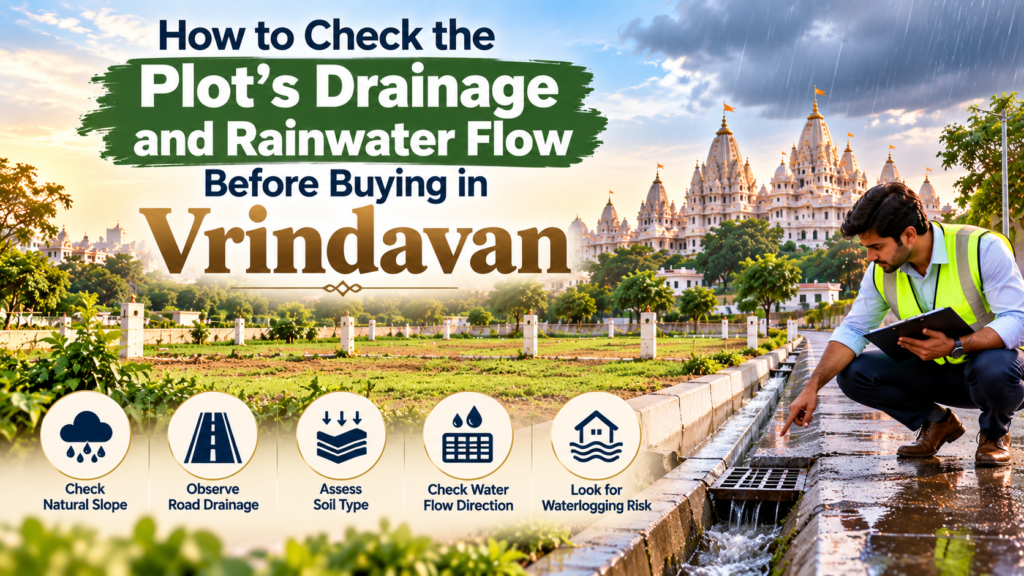
When buying a plot in Vrindavan, buyers usually check location, price, road access, plot size and documentation. Another practical factor that should not be overlooked is how rainwater moves around and away from the plot.
Understanding plot drainage in Vrindavan can help buyers identify potential concerns related to water accumulation, surrounding levels, road drainage and the property’s overall site conditions.
This does not mean that every plot with standing water has a permanent drainage problem. Site levels, rainfall, surrounding development, road construction and local drainage arrangements can all affect water movement.
If you are planning to buy a residential plot in Vrindavan, the following checks can help you evaluate the drainage conditions before making a purchase.
Why Plot Drainage Matters
A plot needs suitable drainage conditions so that rainwater does not remain unnecessarily accumulated around the site.
Poor drainage conditions may create practical concerns such as:
- Water accumulation after rainfall
- Difficult site access
- Moisture around the plot
- Problems during construction
- Soil-related complications
- Difficulty maintaining the site
- Water movement from surrounding properties
Therefore, drainage should be considered along with other property checks rather than treated as an isolated factor.
1. Visit the Plot After Rainfall if Possible
One of the most useful ways to understand drainage is to inspect the plot after rainfall.
During the visit, observe:
- Whether water is standing on the plot
- How quickly water appears to drain
- Whether nearby roads have standing water
- Whether surrounding plots are affected
- Whether water flows toward or away from the property
A post-rain inspection can provide information that may not be visible during dry weather.
2. Check the Plot’s Ground Level
The relative level of the plot compared with nearby roads and properties can influence rainwater movement.
Check whether the plot appears:
- Higher than the surrounding road
- Lower than the surrounding road
- At a similar level
- Lower than neighboring plots
- Higher or lower than nearby open areas
However, visual observation alone may not establish the exact site level. For important construction decisions, a qualified professional can assess the levels more accurately.
3. Observe the Road Drainage
Do not inspect only the plot.
Look at the road directly outside the property.
Check:
- Where rainwater collects
- Whether drains are present
- Whether drains appear functional
- Where water flows during rainfall
- Whether road levels direct water toward the plot
A plot may have reasonable internal conditions but still experience access problems if the surrounding road has poor drainage.
4. Look at Nearby Plots
The surrounding properties can provide useful clues.
During your site visit, observe:
- Standing water on neighboring plots
- Damp ground
- Raised plot levels
- Temporary drainage arrangements
- Water channels
- Construction practices
Do not treat these observations as conclusive evidence, but use them as points for further investigation.
5. Check for Existing Water Channels
Look around the plot for visible routes through which rainwater moves.
These may include:
- Roadside drains
- Open drainage channels
- Sloped ground
- Culverts
- Existing water outlets
- Project-level drainage systems
Understand where water comes from and where it is expected to go.
6. Identify Low-Lying Areas
Low-lying areas can naturally collect water depending on surrounding ground levels.
Check whether the plot or nearby land appears lower than:
- The main road
- Internal roads
- Neighboring plots
- Open land
- Nearby built-up areas
If the site appears significantly lower, ask how rainwater is expected to be managed.
7. Check the Direction of Rainwater Flow
Try to understand the general direction in which water moves after rainfall.
Look for:
- Slopes in the road
- Ground-level differences
- Drainage channels
- Water marks
- Erosion patterns
- Areas where water tends to collect
Do not rely solely on assumptions about the direction of flow. Actual site conditions should be observed or professionally assessed where necessary.
8. Look for Signs of Previous Water Accumulation
Even when the plot is dry during your visit, there may be signs of previous water accumulation.
Look for:
- Mud deposits
- Water marks
- Erosion
- Persistent dampness
- Unusual vegetation
- Soft ground
- Damaged road edges
These signs should be investigated rather than automatically interpreted as proof of a drainage problem.
9. Ask About Rainwater Drainage Arrangements
If the plot is located inside a plotted development, ask the developer or property representative about the drainage system.
Questions can include:
- How is rainwater managed?
- Where does surface water drain?
- Are internal roads connected to drainage?
- Are there designated drainage outlets?
- How is water handled during heavy rainfall?
- Is drainage already developed or planned?
Keep relevant information and documents for future reference.
10. Check the Condition of Nearby Roads
Road construction can affect drainage.
During your inspection, look for:
- Road height
- Road slope
- Drainage openings
- Damaged road edges
- Standing water
- Unfinished internal roads
If the development is still under construction, ask about the planned final road and drainage levels rather than judging only from the current temporary condition.
11. Consider Future Construction
If you plan to build a house on the plot, drainage becomes even more relevant.
Future construction may involve:
- Raising the site level
- Foundation work
- Plinth planning
- Surface drainage
- Rainwater outlets
- Driveway construction
- Landscaping
A civil engineer or other qualified professional can help determine appropriate site preparation and drainage measures for the proposed construction.
12. Check Whether Surrounding Construction Can Change Water Flow
As an area develops, surrounding roads, houses and boundary walls can change the way surface water moves.
Before buying, consider:
- Existing construction
- Vacant plots
- Planned development
- New roads
- Boundary walls
- Changes in surrounding ground levels
Future changes can affect the drainage pattern of a site, so buyers should understand the development context as much as possible.
13. Check the Plot Access After Rain
Drainage is not only about the plot itself.
Think about how you will reach the property during or after rainfall.
Check:
- Main approach road
- Internal road
- Entry point
- Roadside water accumulation
- Vehicle access
- Walking access
A plot can have acceptable internal conditions but still become difficult to access if the approach road is poorly drained.
14. Check for Waterlogging Around the Entrance
Pay particular attention to the plot’s entrance.
Observe whether water tends to collect near:
- Main gate location
- Road intersection
- Driveway area
- Corner of the plot
- Low points along the road
This can become important later when planning a house entrance, parking area or driveway.
15. Ask Local Residents or Nearby Occupants
People who live or work in the surrounding area may have practical information about local conditions.
You can ask:
- Does water collect here during heavy rain?
- How long does it usually remain?
- Does the road become difficult to use?
- Has the drainage situation changed recently?
- Are there seasonal water-related concerns?
Such information should be treated as local observations and combined with your own inspection and professional verification.
16. Compare Drainage Conditions Between Plots
If you are considering multiple plots, compare them using the same checklist.
| Factor | Plot A | Plot B |
|---|---|---|
| Plot ground level | Check | Check |
| Road level | Check | Check |
| Road drainage | Check | Check |
| Water accumulation | Check | Check |
| Nearby drainage | Check | Check |
| Access after rain | Check | Check |
| Surrounding plot levels | Check | Check |
| Future development | Check | Check |
This can make the comparison more systematic.
17. Do Not Judge Drainage Only During Dry Weather
A plot can appear completely normal on a dry day.
Therefore, buyers should consider:
- Previous rainfall conditions
- Seasonal changes
- Local drainage arrangements
- Ground levels
- Nearby development
- Road conditions
If possible, inspect the location under different weather conditions or ask reliable local sources about seasonal behavior.
18. Check the Existing Site Preparation
Some plots may already have site preparation or filling work.
Ask whether:
- The land has been filled
- The site has been leveled
- Soil has been added
- Drainage work has been completed
- The final site level has been established
If the plot has undergone significant filling or leveling, professional assessment can help determine whether additional preparation may be required before construction.
19. Understand the Difference Between Drainage and Soil Issues
Drainage and soil condition are related but are not the same thing.
Drainage concerns how water moves through and around the site.
Soil-related concerns can involve:
- Soil composition
- Bearing capacity
- Settlement
- Compaction
- Ground condition
A proper site assessment may require separate evaluation of both factors, especially before construction.
20. Include Drainage in Your Plot-Buying Checklist
Before purchasing a plot in Vrindavan, add drainage to your regular site inspection checklist.
Check:
Plot level
Road level
Nearby drainage
Rainwater flow
Signs of water accumulation
Surrounding plot levels
Approach road condition
Entrance condition
Existing drainage arrangements
Future development
Site preparation
Professional assessment where required
Conclusion
Checking plot drainage in Vrindavan can help buyers understand how rainwater may behave around a property before purchasing it.
During a site visit, look at the plot level, road drainage, nearby properties, water-flow patterns, entrance access and signs of previous water accumulation. If the plot is part of a development, ask about the existing or planned drainage arrangements.
For buyers planning future construction, professional assessment of site levels, drainage and other ground conditions can provide additional clarity.
A careful drainage inspection, combined with documentation verification, location analysis, road-access checks and other property due diligence, can help you make a more informed decision when buying a plot in Vrindavan.